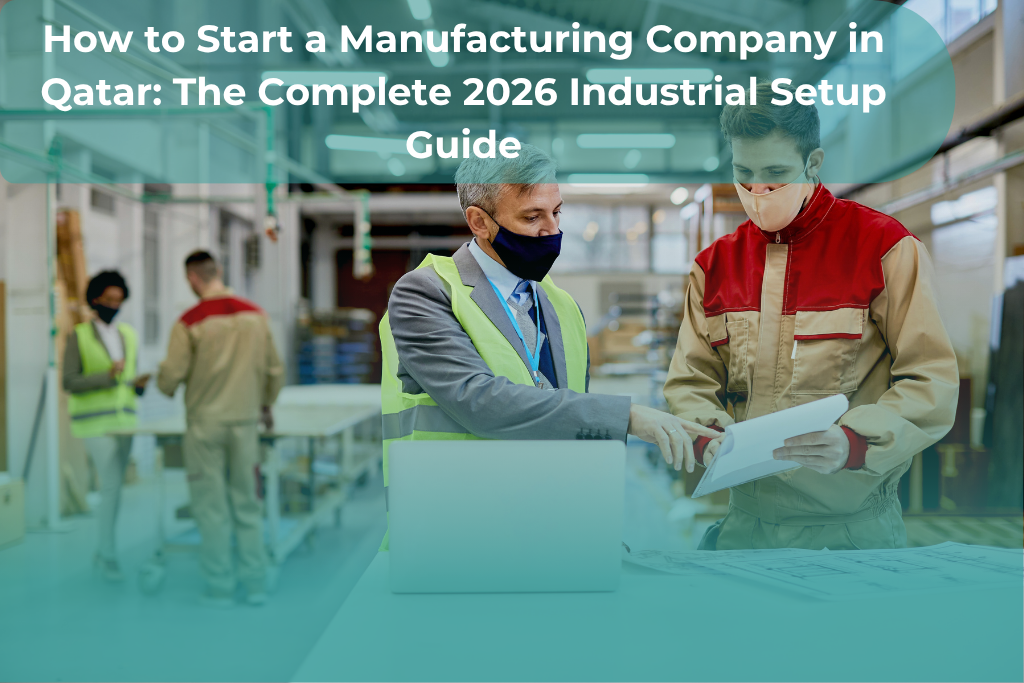
Start a manufacturing company in Qatar and enter a rapidly developing industrial market supported by Qatar’s infrastructure, investment policies, logistics capabilities, and national industrial development objectives. From food processing and construction materials to machinery, chemicals, plastics, pharmaceuticals, and advanced manufacturing, Qatar offers opportunities across a wide range of industrial activities. Investors planning company formation in Qatar for manufacturing activities should understand the regulatory, licensing, and operational requirements before starting the setup process.
However, establishing a manufacturing business involves more than simply registering a company. Entrepreneurs must consider the appropriate legal structure, business activity, commercial registration, industrial approvals, suitable factory premises, environmental requirements, production facilities, employee requirements, and ongoing compliance.
Before committing capital, industrial investors must understand the strategic and financial advantages of setting up a factory in Qatar compared to other regional hubs.
The government of Qatar, acting predominantly through the Qatar Development Bank (QDB) and the Ministry of Commerce and Industry, gives strong backing to domestic manufacturers.
With the expansion of Hamad Port (one of the largest greenfield ports in the world) and Hamad International Airport’s massive cargo terminals, importing raw materials and exporting finished products is highly efficient.
Your first major decision is determining the legal structure of your manufacturing company. This decision dictates where your factory can be located, your tax liabilities, and who owns the assets.
If you plan to sell your products in Qatar without any limitations, then the best way to establish your business is to set up a mainland LLC.
If the main objective is to export manufactured products, QFZA might be a good choice.
First, it is important to figure out what type of product will be produced by the factory.
Products can be:
It is important to determine the activity since different types of manufacturing activities require different regulations, safety measures, and licenses.
MOCI offers industry-specific information using the industry services platform.
In order to register the company, investors should check:
Choosing the right activity is important from the very beginning to prevent problems in the future.
Once the manufacturing activity is determined, the next step is the appropriate choice of legal structure. Investors exploring other business structures can also review options such as register a company in QFC and understand how the appropriate structure depends on the nature and requirements of the business.
A Limited Liability Company (LLC) is one of the legal forms of company under Qatar’s Companies Law. MOCI states that an LLC can be formed with a minimum of one partner and maximum of fifty, with no minimum capital amounts required for registration.
Foreign investors should pay attention to the ownership issue as the maximum ownership percentage differs depending on applicable activity and legal framework for foreign investment.
Following determination of the legal structure and activity of the business, the incorporation steps will need to be taken. After completing the registration process, businesses may also need support with opening a corporate bank account in Qatar and other post-registration requirements.
For the LLC, MOCI sets forth a number of essential requirements:
The incorporation documents must be in accordance with the legal formalities required by law. Depending on the documents involved, investors may also require notary public Qatar services for document authentication and related legal formalities. Businesses that require assistance with government documentation and administrative procedures may also consider PRO services in Qatar to help coordinate relevant government-related processes.
Setting up a plant in Qatar is one of the most crucial steps in launching a business.
MOCI has classified industrial operations into three stages:
In the start-up phase, one can get the initial approval. The construction phase deals with licensing for opening an industry. This phase is the phase when the licensing and registration of an industrial start-up takes place.
According to MOCI, obtaining the industrial license entails getting registered in the commercial register, having a proper site for the industrial activity, and being compliant with the environmental and safety regulations.
Depending on the kind of industry, the business needs to obtain various other approvals from state authorities.
A manufacturing entity seeks an appropriate site for its operations. The site must be appropriate for the intended manufacturing process and must meet the relevant industrial, environmental, safety, and planning rules.
The site could encompass various places including the officially designated industrial areas and other approved locations.
Before entering into a long-term lease agreement, investors should inquire about the following matters:
This stage is of utmost importance because selecting a site before its compliance with regulations can generate additional expenses.
When the location and industry endorsements move forward, the project will switch to the construction and development process.
MOCI has information about several phases in a factory opening procedure: preliminary allocation, environmental approval and industrial licensing, design preparation and issuance of building permits, accomplishment of construction works and application for services.
In addition, the timeframes may vary a lot depending on numerous criteria:
Before commencing any production processes, it is essential for the business to fulfill necessary operational obligations.
An essential step within the MOCI’s industrial platform is that of operating licensing and transaction regarding industrial institutions.
The factory might be required to prove its compliance with the following:
The company will only be able to start commercial production once all approvals are obtained.
Industrial setup is a marathon, not a sprint. Investors must be prepared for a long lead time before revenue begins flowing.
| Phase | Description | Estimated Time |
|---|---|---|
| Phase 1 | Feasibility Study & Business Planning | 4 – 8 Weeks |
| Phase 2 | MOCI CR & Initial Industrial Approval | 2 – 3 Weeks |
| Phase 3 | Securing Land & Engineering Design | 8 – 12 Weeks |
| Phase 4 | MECC Environmental Clearance (EIA) | 2 – 3 Weeks |
| Total | End-to-End Factory Setup | 4 to 6 Months |
Yes, but it depends on where the plant is established. Free Zone companies can have 100% foreign ownership, while mainland companies generally require 51% Qatari ownership. However, eligible projects may apply to the Ministry of Commerce and Industry for 100% foreign ownership if they bring significant economic benefits to Qatar.
No. The main advantage of having the Industrial License is the opportunity to apply for customs waivers and duties related to the machinery that is used to build your manufacturing facility.
Yes. An Environmental Impact Assessment (EIA) is a crucial requirement for establishing and operating a manufacturing facility. Your factory cannot be built or operated unless it has an approved Environmental Impact Assessment by the Ministry of Environment and Climate Change (MECC), showing how emissions, noise, chemical waste, and water use will be managed.
Yes. The Qatar Development Bank offers industrial loans, project financing, and export support to enterprises intending to set up manufacturing units. These financing and support options are generally subject to the completion of feasibility studies, due diligence, and the applicable eligibility requirements.
Initial Approval allows you to lease land, prepare plans, and obtain environmental clearances. The Operation License is granted after construction, inspection, and the required MECC approval. You cannot manufacture or sell products with only Initial Approval.
Start a manufacturing company in Qatar by first defining your manufacturing activity, selecting the appropriate legal structure, confirming ownership eligibility, registering the company and completing the industrial licensing process.
The process does not end with obtaining a Commercial Registration. Manufacturing projects may also require industrial approvals, suitable premises, environmental clearance, construction approvals, safety compliance and an industrial operating licence. MOCI provides dedicated electronic industrial services covering the establishment, construction and operation stages of industrial projects.
If you are planning to start a manufacturing company in Qatar, QCF Global Services can assist with company formation, documentation, government procedures, licensing coordination and business setup requirements. Contact us today to discuss your manufacturing project and understand the requirements applicable to your specific business activity.
If you plan to start a manufacturing company in Qatar, understanding the licensing process, industrial approvals, environmental requirements, and business setup procedures is essential. Proper company formation in Qatar can help ensure that your manufacturing project is structured correctly and ready for the necessary approvals.
Copyright © 2024 QCF Global Services. All Rights Reserved.