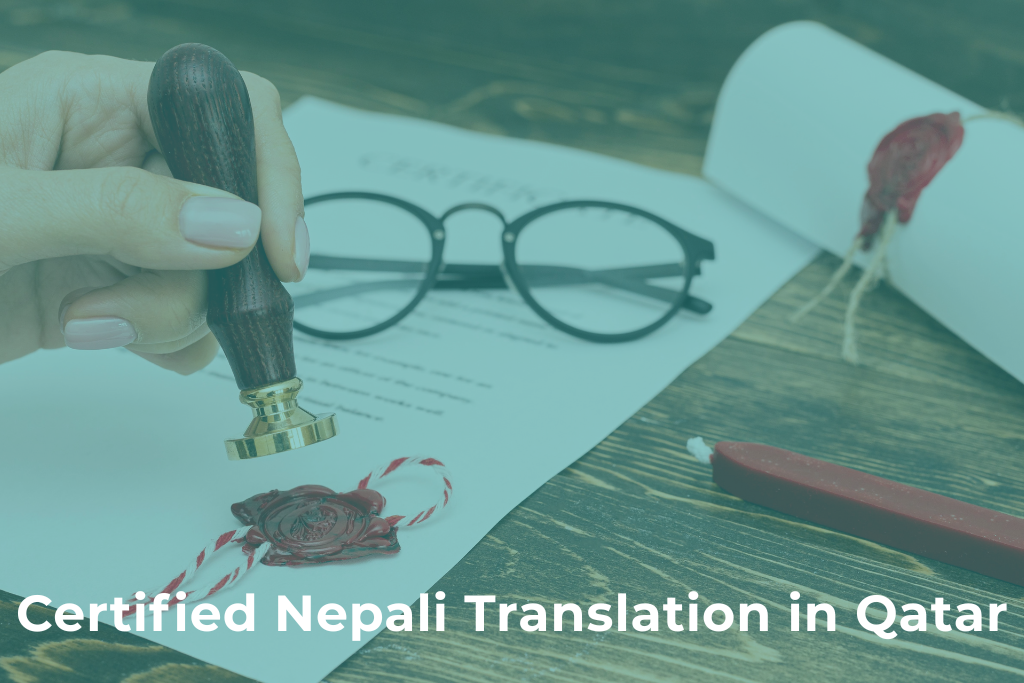
There are many Nepalis in Qatar, and the number is increasing rapidly. One of the main reasons for this is that there are thousands of Nepali nationals working in Qatar across a variety of industries including construction, hospitality, transportation, and other services. In addition, there is a huge requirement for Certified Nepali Translation services in Qatar when it comes to obtaining official, legal, and administrative documents due to the increased population of Nepalis living in the country.
Many of the procedures that must be followed by the government, immigrant applications, legal documents, and employment documentation all require an individual to convert their documentation into Arabic or English in order to be accepted by various authorities. This makes obtaining Certified Nepali Translation in Qatar an essential service to have while living in the country. Certified translations are critical to achieving accurate translations of documents that Nepalese nationals need when submitting official documents, legal documents, or obtaining employment in Qatar, which will help with allowing the productions of documents to be certified in accordance with the governing laws of Qatar.
Arabic serves as Qatar’s primary mode of communication in dealings with local governmental organizations and agencies. For Nepali documentation submitted to governmental entities, oftentimes the documentation will have to be translated into either Arabic or English in advance of submission.
Authorities that may require Certified Nepali Translation in Qatar include:
A basic or simple translation service will not meet the required criteria. Governmental authorities in Qatar will typically require a Certified Nepali Translation because of the necessity of having the translation completed by an accredited Translation Office that produces an official certification and stamp of approval of the Translation Office.
Without certification, documents may be rejected or delayed during processing.
A Certified Nepali Translation is a professional translation of a document that has been verified by an accredited Translation Provider with respect to the document that is to be translated and for which it was to be translated.
There are several defining attributes that are commonly associated with a Certified Nepali Translation, which include the following:
This certification ensures that the translated document carries the same legal validity as the original document when submitted to authorities.
These documents are often required for immigration applications, family residency visas, and legal procedures.
Employers may require translated documents such as:
Using Certified Nepali Translation ensures that employment documents are clearly understood and legally valid.
Legal translations must be highly accurate. Documents may include:
Legal authorities require Certified Nepali Translation to ensure proper interpretation and compliance with local laws.
Companies operating in Qatar may also require translation for:
Professional Certified Nepali Translation in Qatar helps businesses avoid misunderstandings and legal disputes.
Students and professionals often need Certified Nepali Translation for:
These documents are required for employment verification, professional licensing, or educational equivalency.
Accuracy is extremely important when translating official documents. Even small errors can create serious problems.
Incorrect translations may lead to:
Professional Certified Nepali Translation ensures that documents are translated with correct terminology, formatting, and meaning.
Experienced translators understand both Nepali and Arabic legal terminology, ensuring that documents maintain their original intent and accuracy.
Obtaining Certified Nepali Translation in Qatar typically involves several steps.
Step 1: Document Submission
The process begins by submitting the original document or a clear copy to the translation office.
Step 2: Professional Translation
Licensed translators carefully translate the document into Arabic or English while preserving its exact meaning.
Step 3: Certification and Stamping
After translation, the document is stamped and signed by the authorized translation office.
Step 4: MOFA Attestation (If Required)
If the document must be used internationally or for embassy purposes, it may require MOFA attestation after translation.
Following these steps ensures that Certified Nepali Translation in Qatar meets all legal requirements.
Many individuals and organizations require Certified Nepali Translation, including:
Because of the large Nepali population in Qatar, demand for Certified Nepali Translation continues to grow.
Using non-certified translation services can lead to serious complications.
Without Certified Nepali Translation in Qatar, individuals may experience:
To avoid these risks, it is always recommended to use authorized translation services that provide certified translations recognized by authorities.
Nepali citizens applying for immigration procedures often require Certified Nepali Translation.
Examples include:
Certified translation ensures that immigration authorities clearly understand the content of the submitted documents.
Companies operating in Qatar must ensure that contracts and agreements are properly translated.
Using Certified Nepali Translation in Qatar provides several benefits:
Businesses that employ Nepali workers often require translation of employment agreements to ensure transparency and legal compliance.
1. What is Certified Nepali Translation in Qatar?
It is a professional translation service where Nepali documents are translated and officially certified by a licensed translation office.
2. Why is certified translation required in Qatar
Government authorities require Certified Nepali Translation in Qatar to ensure documents are accurate and legally valid.
3. Is MOFA attestation required after translation?
In many cases, yes, especially for international or embassy submissions.
4. Can non-certified translations be used?
No. Most authorities require Certified Nepali Translation in Qatar for official submissions.
5. Which documents require certified translation?
Personal, educational, legal, and commercial documents often require certified translation.
6. Can translated documents be used for court submissions?
Yes, courts usually require a certified Nepali Translation in Qatar to ensure the document is legally valid.
7. Who provides Certified Nepali Translation?
Licensed translation offices approved by local authorities provide Certified Nepali Translation.
8. Is a certified translation required for police clearance certificates?
Yes, police clearance certificates often require a Certified Nepali Translation in Qatar for immigration or employment purposes.
9. Can Nepali documents be translated directly into Arabic?
Yes, professional translators provide Certified Nepali Translation in Qatar directly into Arabic for official submissions.
10. Do employers require certified Nepali translations?
Many employers require Certified Nepali Translation in Qatar for educational certificates and employment documents.
Obtaining Certified Nepali Translation is essential for individuals and businesses submitting documents to government authorities, immigration departments, courts, and embassies. Accurate translation ensures that documents are legally recognized and accepted without complications. If you require professional assistance with document translation services, contact us for reliable support.
Whether for employment procedures, education applications, immigration processes, or commercial activities, Certified Nepali Translation in Qatar provides the reliability and credibility required in Qatar’s regulated environment. Using professional translation services ensures that documents are translated correctly, certified properly, and accepted by authorities.
For individuals and businesses dealing with Nepali documentation, certified translation services remain an important step in ensuring compliance, accuracy, and smooth processing of official procedures.
If you need certified Nepali translation in Qatar, our experts provide accurate and reliable translation services in Qatar for legal, business, and personal documents. We ensure a smooth and hassle-free process. Contact us today to get started.
Copyright © 2024 QCF Global Services. All Rights Reserved.